Process automation · ACL powered by DataArt

Process automation services with RPA and AI

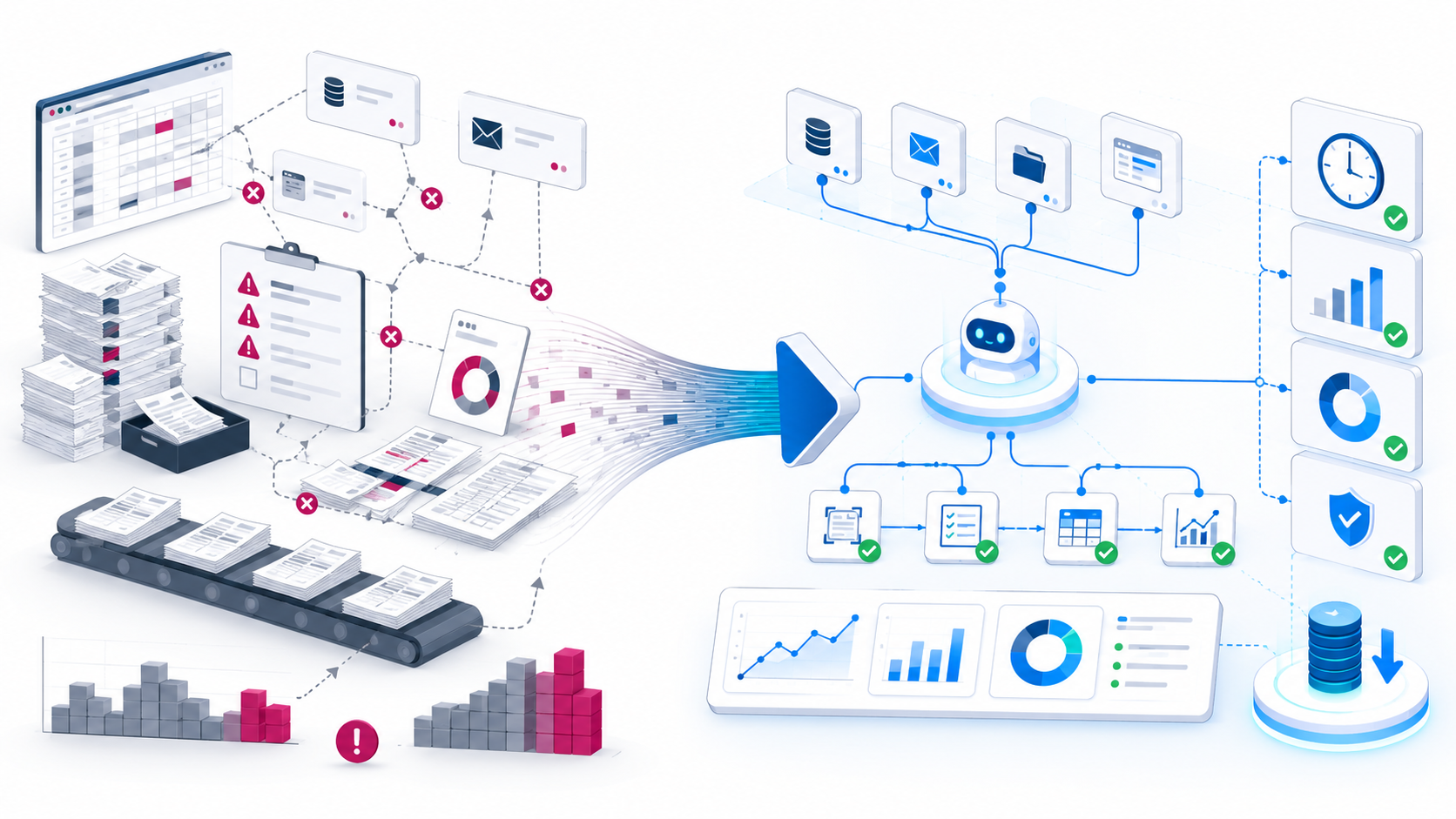
We automate operational processes end to end: RPA robots where the task repeats, AI where documents need interpreting, and ongoing maintenance and evolution when the process changes.

ISO 9001:2015
ISO/IEC 27001:2022
In short

What a process automation service is

The process automation service from ACL (ACL powered by DataArt), a Chilean technology services company in business since 1991, identifies which tasks in a process are worth automating, chooses the right layer for each one (RPA robots, system integration, or AI to interpret documents), and puts it into production with monitoring, exception handling, and ongoing maintenance and evolution.

What does a process automation service do?

It decides which tasks to automate, with which layer, and how they keep running in production.

As an RPA and process automation company, ACL starts with an assessment that measures hours, errors, and rework, tests the solution on a narrowly scoped process, and adjusts it through ongoing maintenance and evolution when the process changes.

Criteria

RPA, integration, or AI: how we choose the layer

Classic RPA automates the repeatable task and breaks when the process changes. That is why the first step is choosing the layer, and sometimes the answer is that you don’t need a robot.

LayerWhen it fitsACL example
RPA robotThe task repeats with clear rules on systems without an API, such as external portals or legacy applicationsRegulated banking: automated integration with UiPath between a complaints platform and external entities
Integration in the source systemThe process lives in your own systems, with access to the data. Automating at the source is more stable than a robot working on the screenPayments: automated transaction reconciliation that cut rejected transactions by 90%, delivered in 60 business days
AISomething needs interpreting: documents, free text, request classification, or natural-language responsesAnalytics: an AI assistant for querying a document repository in natural language. We cover it in artificial intelligence for enterprises
AI + automationAI reads the input (a document, a request) and the robot or integration carries out the next stepsHigher education: applicant evaluation with Power Automate and Azure OpenAI, with analyst review
Service

What the service includes: from assessment to ongoing maintenance and evolution

The robot is one piece. The service covers what it needs to keep running when the process changes.

  1. Baseline assessment

    We measure hours, errors, and rework in the current process and prioritize where automation pays off and how quickly, before we write a single line of code.

  2. Design and proof of concept

    We propose the optimized model and the layer for each task, and test it on a scoped segment of the process.

  3. Build and QA

    We develop robots and integrations with exception handling. A QA analyst tests them before they go to production.

  4. Go-live

    We deploy the automations on your infrastructure.

  5. Ongoing maintenance and evolution

    We adjust the automations when the process changes, as on the banking platform we have maintained for more than four years.

Platforms

Automation platforms we work with

We recommend the platform during the assessment, based on your process and your licensing. These are the RPA and automation solutions ACL has implemented.

  • RPA robots with UiPath

    Automated integration with external entities on a bank’s complaints platform, with ongoing maintenance and evolution for more than four years.

  • Low-code flows with Microsoft Power Automate

    They connect systems and AI services, as in the applicant evaluation with Azure OpenAI for a higher education institution.

  • Direct integration, no robot

    When the data is available in the source system, we automate there, as in the transaction reconciliation for a payments company.

Process automation case studies

Two ACL projects in banking and payments.

See more automation case studies
Regulated banking

End-to-end complaints management platform

Result

Sustained regulatory compliance and fewer escalated complaints. More than four years of continuity with ongoing maintenance and evolution; 2,440 hours in the 2023 ecosystem phase and expansion to 3 partners.


Regulated banking

End-to-end complaints management platform

Result

Sustained regulatory compliance and fewer escalated complaints. More than four years of continuity with ongoing maintenance and evolution; 2,440 hours in the 2023 ecosystem phase and expansion to 3 partners.

Challenge
Respond to inquiries and complaints within legal deadlines, to avoid escalations and penalties from regulators.
Solution
An end-to-end complaints management platform, with automatic alerts and escalations based on deadline risk, and automated integration (RPA with UiPath) with external entities. In 2023 it joined an ecosystem shared among partners. Angular, Java, Spring Boot, and UiPath, on a hybrid cloud and on-premises architecture.
Payments

Automated transaction reconciliation

Result

−90% rejected transactions, by detecting gaps in the authorizer’s rules, and an end to daily manual reconciliation. Delivered in 60 business days, on time and on budget.

Payments

Automated transaction reconciliation

Result

−90% rejected transactions, by detecting gaps in the authorizer’s rules, and an end to daily manual reconciliation. Delivered in 60 business days, on time and on budget.

Challenge
Transactions with international card brands were not automatically validated against the core system or against accounting. There was daily rework and accounting risk, across two brands and two currencies.
Solution
Two-stage automated reconciliation (received transactions, posted operations, and management statuses), a daily dashboard, tracking of unposted transactions, and digital signature with audit reports.

Learn about our work in software and data for banking and financial services.

Which process takes up the most hours? Let’s start by measuring it.

Map the processes you can automate
Control

Control and auditing of automations

Every automation has to leave evidence of what it did and of who is accountable for it.

  1. Owner and monitoringEvery automation has an owner, monitoring, and exception handling, so a failure doesn’t go unnoticed.

  2. Audit evidenceReports and digital signature for audits, as in the automated reconciliation for a payments company.

  3. Regulated processesExperience with regulated processes, such as a bank’s complaints management under legal deadlines.

  4. Certified securityACL operates with an ISO/IEC 27001:2022 information security management system and an ISO 9001:2015 quality management system. See our ISO 9001 and ISO/IEC 27001 certifications.

ISO 9001:2015 · RI 9000-9942ISO/IEC 27001:2022 · RI 27000-88Certified by IRAM, with IQNet recognition
Backing

ACL, in Chile since 1991, is part of the DataArt group

  • 6,000+engineers and consultants · DataArt group
  • 40+locations · DataArt group
  • 80NPS · DataArt group, 2025
  • 95%client retention · DataArt group, 2025

Companies that trust ACL

  • Esmax
  • Nexus
  • Rheem
  • Sparta
  • Deloitte
  • Blue Express
  • Oxiquim
  • AFC Chile
  • BTG Pactual
  • Banmédica
  • Taivo (formerly Inktavo)
  • Antofagasta Minerals
  • Caja Los Héroes
  • Accenture

Frequently asked questions about process automation and RPA

What does a process automation service include?

It includes everything the automation needs to work in production: assessment, design, proof of concept, build with QA, go-live with exception handling, and ongoing maintenance and evolution.

At ACL, the assessment prioritizes which tasks to automate and how quickly they pay for themselves, and the design chooses the layer for each one: RPA, integration, or AI, depending on the case.

Which processes should you automate first?

Start with high-volume processes that have clear rules, digital data, and a visible cost when they fail, such as reconciliations, data loads between systems, or back-office validations. That was the case with the transaction reconciliation ACL automated for a payments company.

A process that changes every month should be redesigned before it is automated.

Which platforms does ACL work with as an RPA consultancy?

ACL has implemented RPA robots with UiPath and low-code automation flows with Microsoft Power Automate.

If you haven’t chosen a platform yet, the recommendation is part of the assessment, based on your process and your licensing.

How long does it take to implement an automation?

As a reference, ACL delivered the automated transaction reconciliation for a payments company in 60 business days, on time and on budget.

The timeline depends on how many systems the process touches, whether they expose APIs, and how many exceptions need handling. That is why the assessment defines the scope before we build.

What happens to the robots when the process changes?

They are adjusted through ongoing maintenance and evolution, so the change doesn’t stop operations. That is why we design every automation with an owner, monitoring, and exception handling.

At a regulated bank, the platform with RPA integration that we built has had more than four years of ongoing maintenance and evolution, and in 2023 it expanded to an ecosystem of three partners.

When should you use RPA, and when artificial intelligence?

Use RPA when the task repeats with clear rules and structured data, such as loading data between systems or reconciling records. AI comes in when you need to interpret a document, classify free text, or draft a response.

In many processes they work together: AI reads and the robot executes in your systems. If your project centers on AI, see our artificial intelligence for enterprises service.

How do you measure the return on an automation?

It is measured against a baseline taken before automating: the process’s labor hours, errors, rework, and cycle time. After go-live, the same metrics are compared, net of licensing and maintenance costs.

In ACL’s assessment, we estimate that return before we build.

When automation needs AI

  • If the process starts with documents, such as invoices, forms, or contracts, AI reads them and hands structured data to the robot.

  • If AI is at the center of the project, such as an assistant or a decision engine, we handle it in our artificial intelligence for enterprises service.

  • AI agents are already part of how we build software: with SPIREX®, our agentic orchestration framework, every stage of development passes through a human gate (Human-in-the-Middle).

Resources

Articles on RPA and automation

Review a process with ACL’s automation team

Together we measure volume, rules, the systems involved, and exceptions, and we choose the layer: robot, integration, or AI.

Map the processes you can automate